Anyone arriving at the site will find that the records from 4 of the historical years have been presented in detail. These let you see the actual case materials on which we’ve based some of the conclusions we’ve drawn.
But we have 46 more years’ worth of historical records ready to be loaded. These might provide the basis for an MA or DPhil or PhD thesis. We can make the records for any of these years available to anyone interested to engage. The hope is that anyone doing so would try to replicate or develop what Margaret Harris has done for 1875, 1890, 1905 and 1920. This would involve curating the records for display and chasing historical detail on issues locally or globally linked to that year that the cases in these records prompt.
Our hope is to make this site of interest for visitors from Argentina to Japan by being intensely local. Our belief is that if people from anywhere in the world look closely at what happens in a particular area they will recognise commonalities between the experience there and their own.
This means that we hope anyone adopting a year or group of years will chase:
local North Wales details
local details from elsewhere that brings out common features between there and North Wales
details that add to our understanding of Mental Health and its disorders as well as general medicine and its disorders
In due course we will supplement what’s here with material that will be broadly labelled perhaps ‘1950’ telling the story of mental health in the period between the historical era and the contemporary era.
There will also be a further section, notionally termed 2001, which will give a picture of the patient flow through the Hergest Unit in North West Wales in that year and will help bring out the changing features between now and the historical period.
In terms of local detail the politics of healthcare in North Wales in recent decades has been fascinating and recapitulates the story that led to the founding of the North Wales Asylum in the first instance. The hope here is that bringing out aspects of the contemporary picture will enable people to better understand the factors that were at play in the historical period also – it will help humanise the historical period.
This is an active site. In addition to using the site to get a research degree, you can become part of the Madness as:
An informal researcher struck by some curiosity of healthcare or mental healthcare history that you feel would be of interest to others coming to this site
As someone interested in the historical period and keen to bring out social aspects of this that have impinged on healthcare either in the UK or anywhere else in the world
As someone from North Wales who has photographs or other artefacts that might help feed the imagination of people visiting the site.
As an artist stimulated to write a story, play or poem bearing on mental illness that could sit beside the stories from Dangerous Asylums already on the site.
As someone aware of stories, plays and poems bearing on mental illness.
As a musician or composer whose work has links to the themes of health and illness, particularly mental illness (see Night Terrors).
As someone aware of music that tells something of the experience of mental illness 100 years ago or today.
As a visual artist interested to contribute to the material that is here.
In all these cases we would love to hear from you. You can contact us on the details below:
The work that led to this website began in the early 1990s when the Department of History at Bangor University applied for a Wellcome Trust grant to investigate the history of the North Wales Asylum at Denbigh, sometimes called the Denbigh Asylum. The Wellcome Trust knocked the grant back. The world had too many asylum histories, it didn’t need another.
Merfyn Jones, then the Professor of History at Bangor, later Vice Chancellor of the University and Chair of Betsi Cadwaladr University Health Board, along with the lead researcher Pamela Michael recast the grant to cover the interaction between the asylum and social conditions in North Wales at the time. Why and when did the communities in North Wales use the Asylum?
They also tacked David Healy on as a medical element to the application. Healy had recently been appointed as a Senior Lecturer in Psychiatry based in North Wales.
The new application succeeded. It led to several papers by Pam Michael and to a wonderful book Care and Treatment of the Mentally Ill in North Wales 1800 – 2000, which brings out the politics of North Wales surrounding the building of the asylum, and the politics of healthcare in North Wales more generally that play similar roles now in 2017 as they did in 1847. The book gives a vivid picture of North Wales life and customs and the way mental illness presented in North Wales settings. This is traditional history well done. (The Table of Contents and Preface for this book has been provided by Cardiff University Press and can be found at the above link).
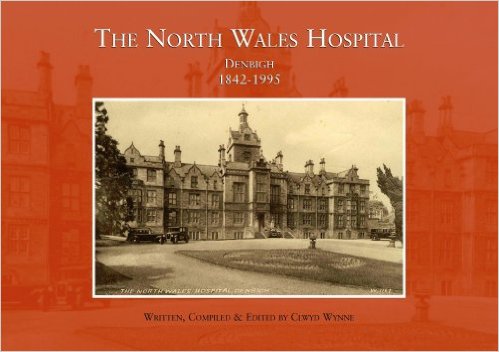
Even before this project had begun a lot of people within the North Wales Hospital were mobilising to preserve some record of the institution. The hospital was scheduled to close in 1995 and one of the senior nursing staff Clwyd Wynne had the brief to collect artefacts and photographs and testimony from both staff and patients about life in the hospital. This lead to the formation of the North Wales Hospital Historical Society and later their website [no longer available at http://northwaleshospital.btck.co.uk/]. It also lead to a book by Clwyd Wynne on the North Wales Hospital Denbigh 1842-1995, with the majority of the photographs featured on this website having been kindly donated by Clwyd.
Historical Epidemiology Emerges
The history embodied in Pam Michaels’ book illustrates the ways in which mental illness presented itself in North Wales 100 years ago. Compared with now it is striking how people for example declared their illness then by escaping from attention through the windows of their houses or by taking their clothes off. This doesn’t happen now. People then didn’t overdose or cut their wrists the way they do now.
Fascinating though this was and is, Healy and colleagues became interested in the quantitative opportunities thrown up by the North Wales Hospital records. Michael’s work involved entering 1 in 10 of all admission records to the asylum. Healy funded the project to enter all records of admissions from North West Wales for the years 1894, 1895 and 1896, with a view to comparing the profile of admissions to admissions to today’s replacement service, the then newly opened District General Hospital, Mental Health Unit, the Hergest Unit, in 1996.
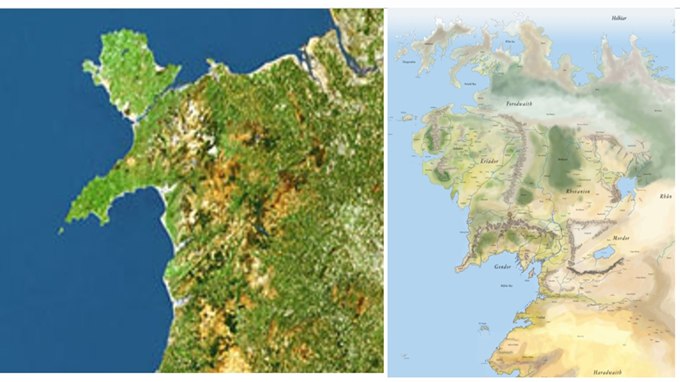
North Wales was made by God for comparisons like this. It is the settling in which Tolkien based Lord of the Rings, with its mountains and castles. The maps of Middle Earth that appear in the Lord of the Rings show the same configuration as North West Wales.
On the left is a map of North Wales, on the right Middle Earth from Lord of the Rings. Tolkien based his story on North Wales geography, with the Hergest Unit based right in the middle of the Shire.
The region is bounded by the sea and mountains on all sides, so that 100 years ago and even now it is not easy to access mental health care from outside the area.
The area was and is poor so that almost all healthcare access was and is through public facilities – there was very little private care.
The area was rural then and remains so today.
It was ethnically homogenous then with 80% of the surnames being traditional Welsh names and is ethnically homogenous now with over 60% still being traditional Welsh surnames.
This meant that with appropriate adjustments for population and control for shifting age bands, from a younger population 100 years ago to the population structure now, it becomes possible to compare the rates at which patients went into the North Wales Hospital 100 years ago and the rates that they enter the Hergest Unit now.
At this point – in September 1998 – Margaret Harris came into the frame. It was becoming clear that the differences between 1896 and 1996 were likely to be striking and that more work would be needed. Harris had majored in history in Bangor University as a mature student and answered an advert for a researcher on the project, a role she filled from 1998 to 2015.
The first striking fact to emerge from the comparison of 1896 and 1996 was that there were far fewer admissions in 1896 compared with 1996. We had to bundle together 3 years’ worth of admissions to make it possible to compare what had been happening then with what happens now.
The second was that the perception that mental health care takes place in small hotel like units now with patients staying for much shorter periods of time and that the care is more effective than before was wrong. We have an enduring image that patients then spent their whole life in the asylum along with over a thousand other inmates in hospitals that had been built to accommodate 100-200 patients at the most but had expanded to hold 1500-2000. This image began to seem wrong.
The third was that the conditions people had were recognisably the same 100 years ago as they are now. Indeed faced with clinical records that contained not just the descriptions of the patient when they came into hospital 100 years ago but also a full record of all later admissions if there were any or the entire course of the patients admission in hospital if they stayed in hospital, it was easier to make diagnosis that several clinicians agreed upon than it is to get agreement on the diagnosis for patients today. Today’s patient on first presentation without the evidence of a clinical course can be far harder to diagnose.
The first article laying out these findings was published in 2001 (see Psychiatric Bed Utilization: 1896 and 1996 compared). To publish it, Harris, Healy and others needed to learn the language of epidemiology and the epidemiologists to whom they turned – Ezra Susser and colleagues in Columbia – had to learn some history.
It was now clear we needed to enter as many records from the past and the present as we could. The records from 1875 to 1924 provided a particular complete group. The Hergest Unit had opened up in 1993. We entered the key demographic and clinical details of all patients entering this Unit between 1994 and 2010.
The ability to make diagnoses and track the course of an illness but also the ability to have a system which gave us a good estimate of the actual number cases each year in a population which remained curiously constant over 100 years then threw up a real surprise – the appearance and disappearance of illnesses.
The first intimation that illnesses might appear and disappear came with the evidence of the disappearance of classic post-partum psychosis. The usual response to this statement is that we still have post-partum psychoses – what are you talking about? There are experts on post-partum psychosis and the profile of this condition remains quite high but in fact the traditional illness has disappeared. Of the cases admitted 100 years ago, 80% were de novo onset in women who had no prior mental health histories and who had not further mental illness once the problem cleared up. It was an intense disorder, with features of delirium. This disorder rarely if ever happens today. The cases we have now are in fact first or further episodes of bipolar disorder that often antedate the post-partum episode which clinically look very different to the cases of post-partum psychoses 100 years ago. And while we were mapping admissions in the modern period, the mother and baby unit in the Hergest Unit, set up for post-partum psychoses closed down. There were no cases. Other mother and baby units across Britain also closed (see Tschinkel et al 2007: Post Partum Psychosis: two cohorts compared, 1875-1924 and 1994-2005).
A second surprise came with our abilities to map the clinical course of Jerusalem syndrome or the schizoaffective or schizophreniform disorders that happen at times of social dislocation. The Welsh Revival in 1904 led to a spike in admissions to the asylum of people with acute and transient psychoses. We were able to track these patients later in life and see what happened. Did they come back into hospital or was the temporary insanity linked to the enthusiasm of the revival against a background of strikes in the North Wales quarries something that was a once off episode? The data made it clear that there were indeed schizophreniform psychoses that have a good outcome.
The biggest beast in all psychiatry, lurking in these and other records, is the question of schizophrenia. The records made clear that for the first 20 years of the period we looked at, the incidence of admissions for schizophrenia was on the rise during the 1875 to 1924 period.
But an equal surprise came in the 1994 to 2010 cohort where admissions began to fall after 2003. This rise in the 19th Century and contemporary fall offers scope to investigate what factors might have appeared during the 19th Century to help make certain psychoses chronic and whether those factors have shown a fall recently that coincides with the drop in the incidence of chronic psychoses. Two factors have been of particular interest to us. One has been the issue of lead contamination and the other has been changes in the nature of obstetrical care during the 19th Century and more recently (see The Incidence of Admissions for Schizophrenia).
At several points during this work over a 20 year period we applied to the Wellcome Trust to fund the work and found that they were reluctant to do so. The contemporary material wasn’t history we were told. When we looked for research funding from epidemiological or other contemporary sources, we heard the historical component was a problem – how can one be certain about events in the past like this.
We ended up creating historical epidemiology – something that hasn’t existed up till this and remains largely unrecognised.
Related to this is the fact that when diseases rise this is wonderful for business and everyone is interested but when they disappear as we found with the post-partum psychoses none of those who have an investment in the disorder are pleased. Our article and our data has fallen on deaf ears even though it has been accompanied by a closure of mother and baby unit across North Wales and elsewhere in the UK. The changes have been as visible as they were with the disappearance of tuberculosis.
In the same way one might have thought that evidence for an increase in the incidence and then a fall in the incidence of schizophrenia would be of wider interest but to date there has been very little interest in this possibility even though there are enormous service implications. Mental health services will need to be reconfigured in their entirety if what we’ve found holds true.
All of the above underpins the reasons for wanting to create this website.
To read more and find out how you can get involved see North Wales & You.
HTV’s desperate letter provided inspiration for young Bangor composer Ellie Davies who has dedicated her most recent work ORDINARY MEN to the servicemen from North Wales who lost their lives in the Great War.[1]
Written in operatic form, the work consists of five movements and when composing the fourth movement – Night Terrors – Ellie looked at the anonymised case notes of some of the soldiers who, as a result of their experiences at the front, were admitted to Denbigh Asylum during or immediately after the war. In her own words, Night Terrors ‘depicts the nightmares of men returned from battle adjusting to life at home’.[2]
Scored for mixed choir and a wind ensemble of flute, oboe and bass clarinet the movement includes snatches of songs which would have been familiar to the men from their childhood in North Wales, the lullaby Suo Gan and a hymn which they are known to have sung in the trenches to boost morale Guide me O thou Great Redeemer.
The voices in Night Terrors have a dual purpose with soloists singing direct quotes from the asylum notes while the chorus expresses the raw delirium of a man trapped within his nightmare. The adapted Suo Gan lullaby is repeated at intervals throughout the movement predominantly by the female voices (soprano and alto) representing the attempts of wives and mothers to soothe their distressed husbands and sons.
The following asylum case note perhaps best sums up the theme of Ellie’s sung libretto:
‘Many who are unable to speak voluntarily yet call out in their dreams expressions they have used in trench warfare and battle’
but she has also incorporated the ‘breaths’ and ‘gasps’ of asylum patients in her work and in fact the work opens with ‘audible breaths in all vocal parts’.
Ellie envisages the case notes being acted out on stage with the intensity of the action emphasised by a flickering light focused on a projection of the empty Eisteddfod chair, Hedd Wyn’s ‘Black Chair’, representing all the empty chairs in all the households that sacrificed a young man to WWI.
The first two movements of ORDINARY MEN – Y Caban and Zero Hour – were performed at the Bangor New Music Festival in March 2016 and the third movement Silent Refrain was workshopped by the BBC National Orchestra of Wales Wind Ensemble in Cardiff in April 2016.
Ellie is hoping that the whole work will be performed next year with the possibility of a recording.
Footnotes
[1] The poet Hedd Wyn’s mother referred to the soldiers who fought alongside her son as ‘ordinary men’ – ordinary men caught up in extraordinary times.
[2] Since graduating from Bangor University with a BMus in 2009 Ellie has worked on a number of community music projects. The performance event Gladstone Fired Up! which she conceived and co-directed originated from a workshop devised by Ellie using her own original music to explore the history of a working pottery museum in Staffordshire. She took a version of this workshop to the Arts and Humanities Research Council’s ‘Connected Communities Festival’ in Cardiff in 2014. Ellie is pleased to be back in Bangor now and looking forward to composing and directing more of the community music she enjoys.